Solution case study
RealityAI
Floor-plan-aware multimodal property discovery.
- Role
- Floor-plan POC, multimodal retrieval, ranking, backend API & interaction architecture
- Period
- 2025
- Status
- Completed
- Stack
- GPT-4 · CLIP · Qdrant · Vector Retrieval · Reranking · Backend APIs
One-line summary
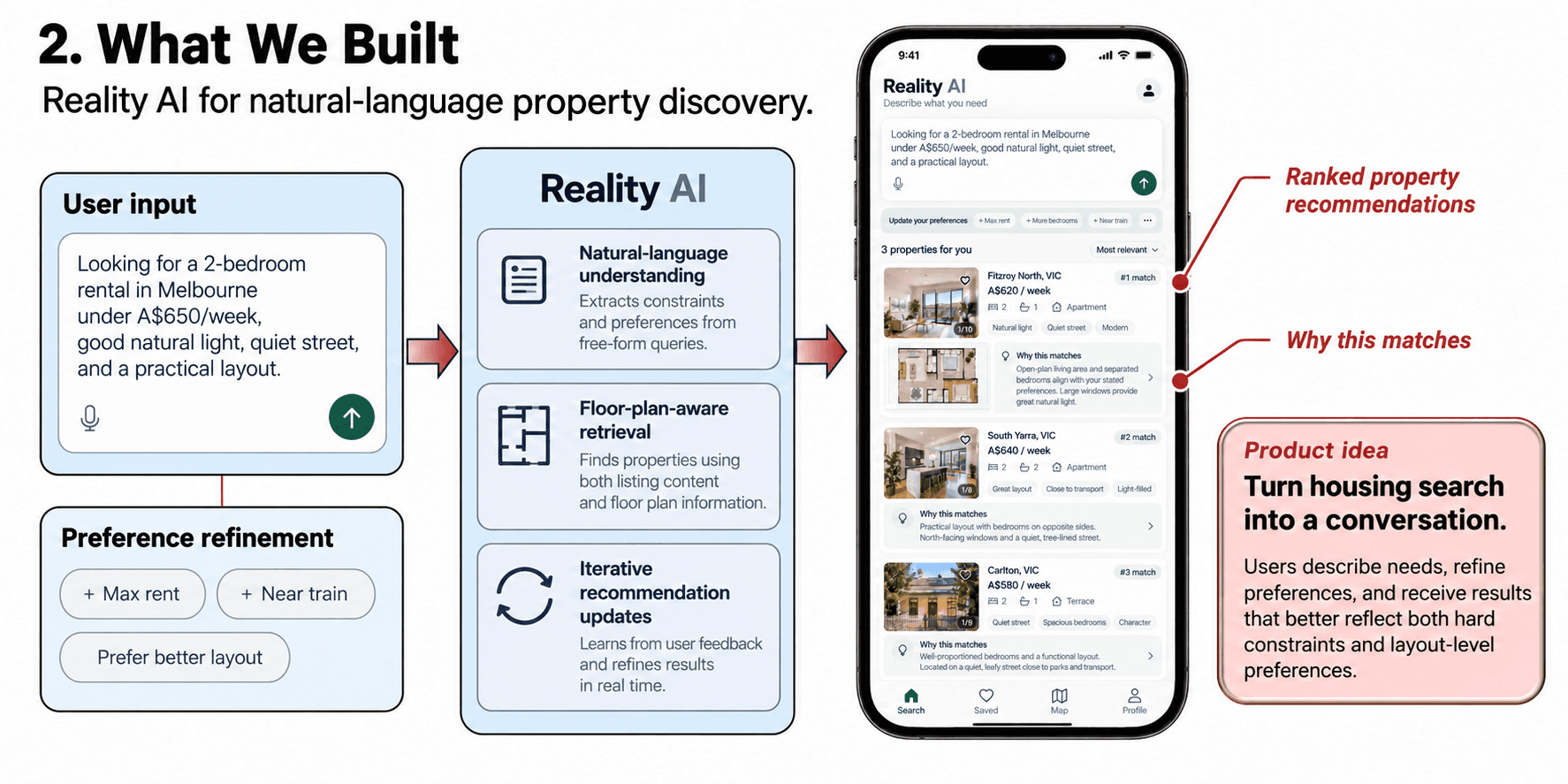
A property-search pilot that turns natural-language needs, listing content, photos and floor plans into ranked, explainable recommendations that users can refine over time.
At a glance
- 01Problem
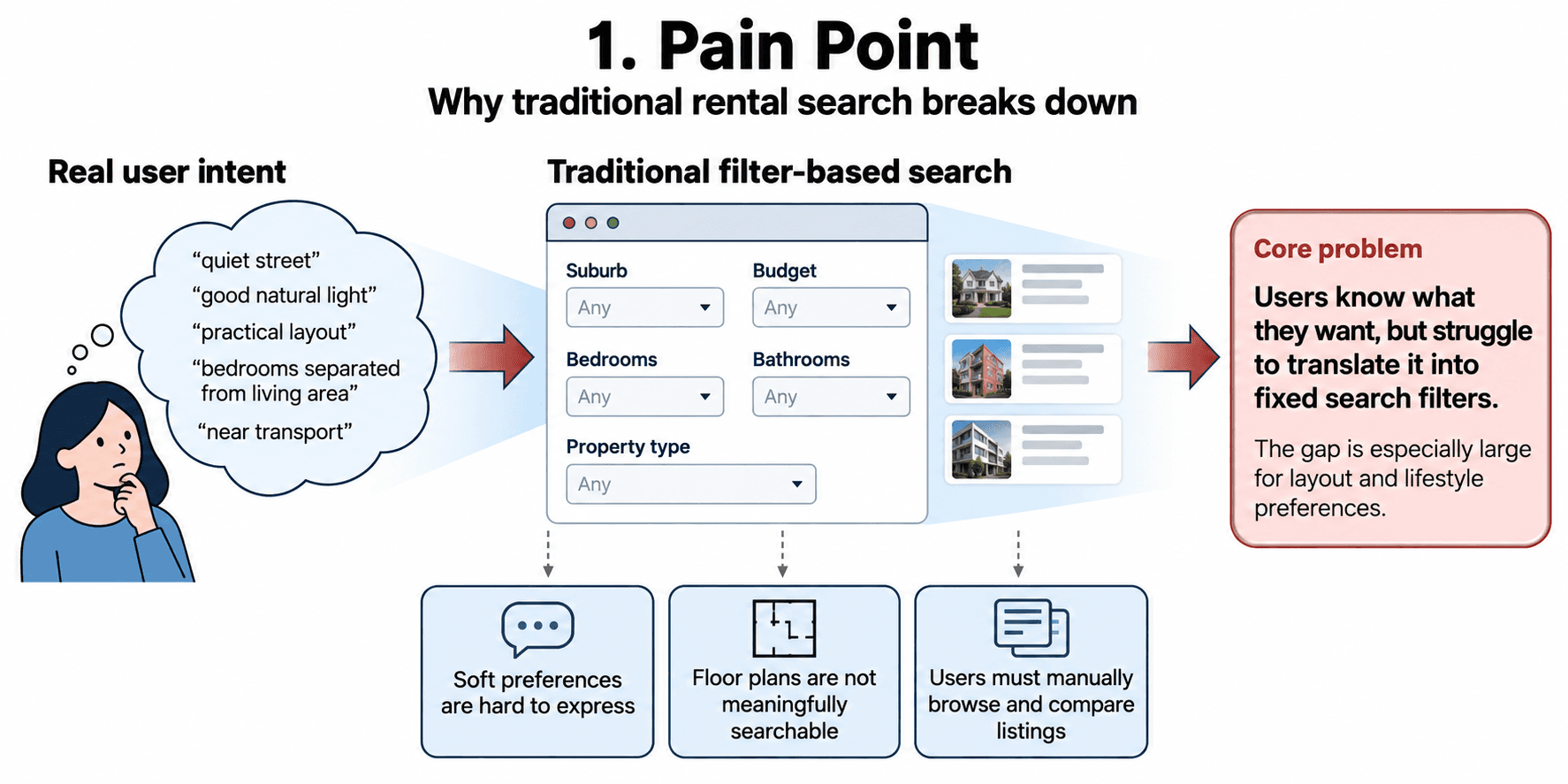
- Fixed property filters capture budget and bedroom count but struggle with softer needs such as natural light, quiet streets and spatial layout.
- 02Context
- An 8-person startup team built and internally tested an early property-discovery pilot, with a 3-person backend team.
- 03My contribution
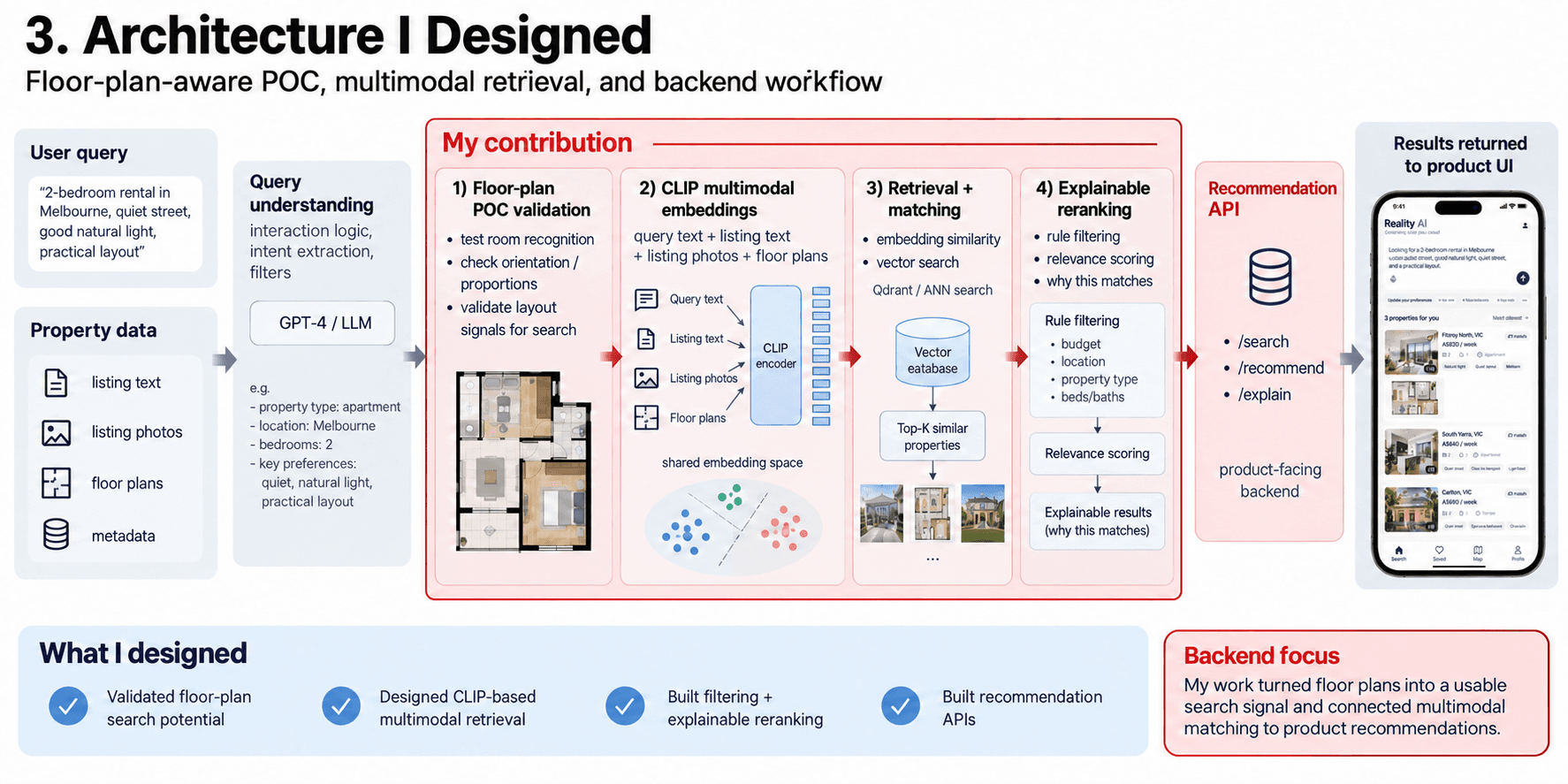
- Validated floor-plan search signals and designed the CLIP retrieval, vector search, rule filtering, explainable reranking, recommendation APIs and interaction architecture.
- 04Outcome
- A pilot that supported natural-language search and iterative preference refinement through limited internal use before development stopped after the founder exited.
Evidence highlights
- Pilot
- product maturity
- 8
- people in the startup team
- 3
- people in the backend team
Internally tested with limited internal use
Full product team
Backend-related development
Three-minute walkthrough
Why fixed filters miss how people describe a home
People can usually state hard constraints such as location, price and bedroom count, but their real preferences also include natural light, quiet surroundings, room proportions and relationships between spaces. Traditional search makes them translate those needs into filters, inspect floor plans manually and repeatedly restart the process.
A recommendation loop, not a one-shot prompt
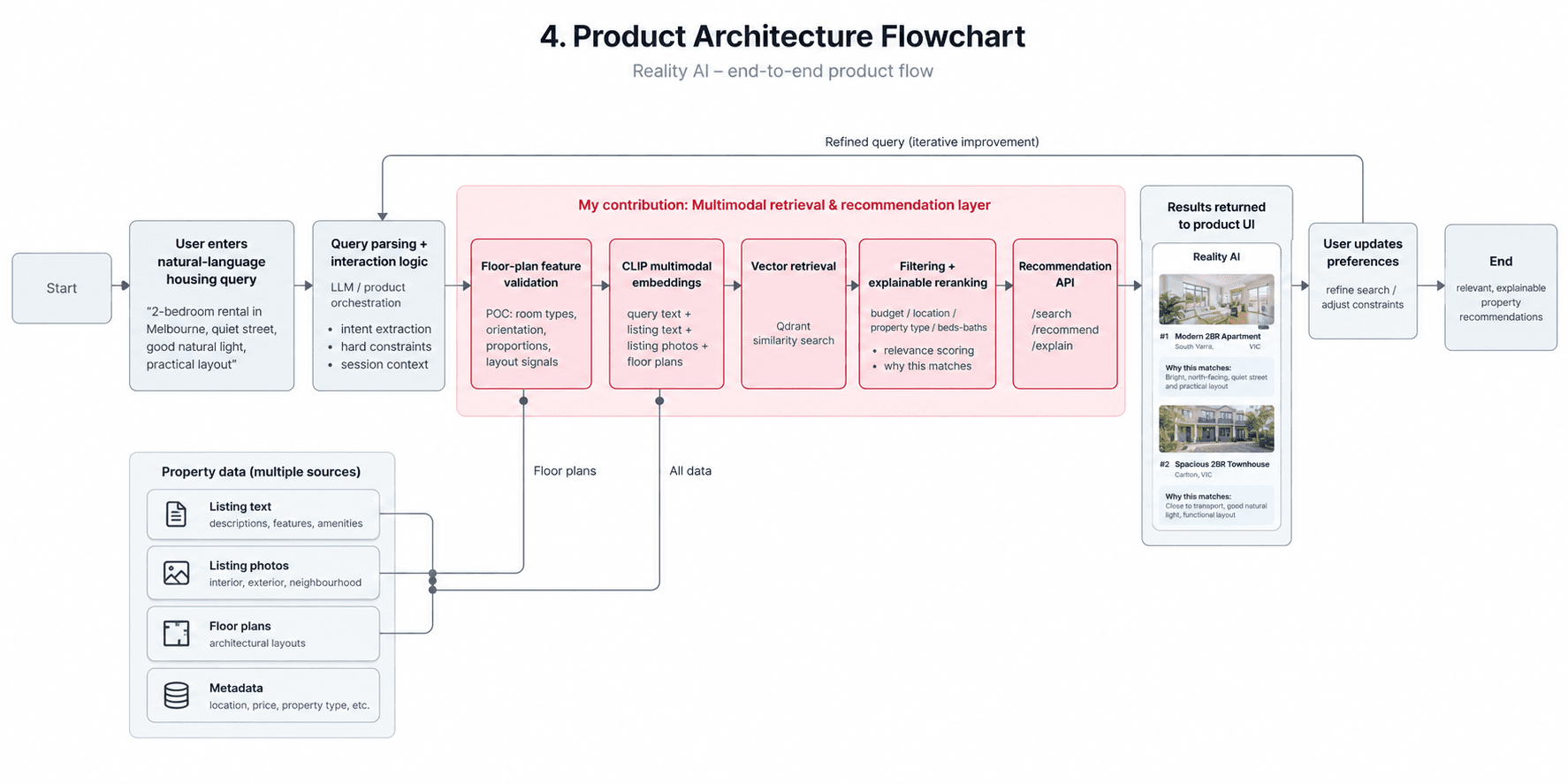
The pilot interpreted a natural-language request, separated hard constraints from softer preferences, retrieved candidate properties using text and image signals, explained the ranking, and let the user refine the preference state instead of starting over. The goal was to turn housing discovery into an iterative conversation grounded in actual listing data.
Treating floor plans as a feasibility question
The floor-plan proof of concept tested whether room types, orientation cues, relative proportions and layout relationships were reliable enough to help search. It did not aim for CAD-grade reconstruction. The narrower product requirement was to extract signals that could improve retrieval and ranking while keeping their limitations visible.
Connecting multimodal retrieval to a usable product
CLIP placed query text, listing text, property photos and floor-plan images in a shared representation space. Qdrant supplied vector retrieval, while structured filters enforced budget, location, property type and bedroom or bathroom requirements. An explainable reranking layer combined the valid candidates and returned both an ordering and a concise reason for each match.
How the contribution fit into the complete system
The retrieval and recommendation layer sat between property data and the user experience. Query parsing and product orchestration supplied intent; the highlighted layer validated floor-plan features, created multimodal representations, retrieved and reranked candidates, and exposed search, recommendation and explanation results to the interface.
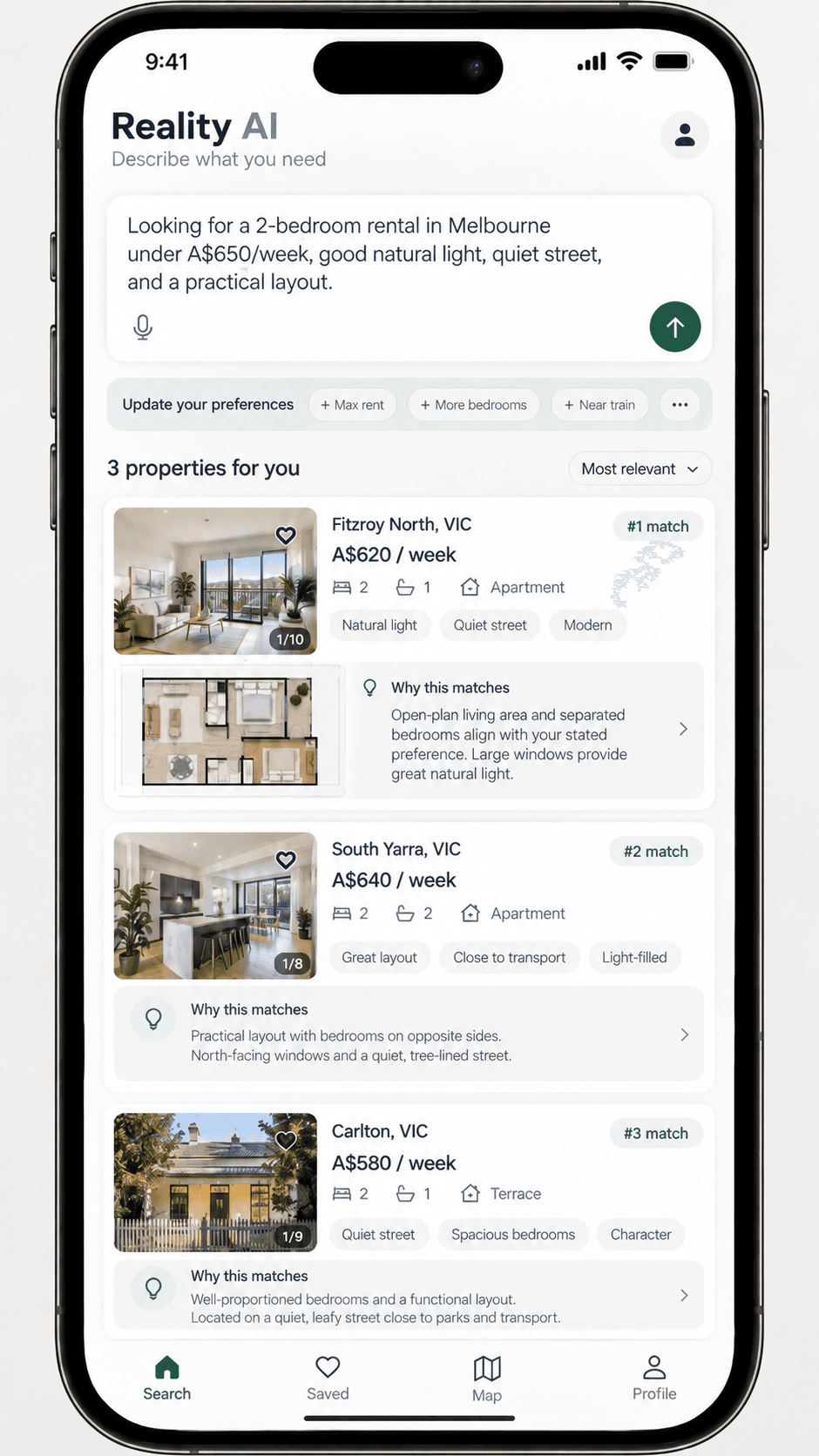
Explaining why each property matched
The mobile interaction concept joined ranked properties with floor-plan-aware match reasons and controls for updating preferences. It represents the intended product experience around the implemented pilot rather than a claim that this exact interface was released publicly.
Pilot evidence and why the project ended
The 8-person startup team reached a pilot that was internally tested and saw limited internal use; three people worked on backend-related development. The project concluded after the founder exited, not because an external adoption or performance study had established success or failure. The evidence here is the implemented pilot, its architecture and the attributable technical work—not a public release, external user adoption or quantified business outcome.