Solution case study
LLM Agent–Embedded Cruise Procurement Platform
A full-stack cruise procurement platform that embeds an LLM agent inside an approval-gated workflow spanning document intake, RFQ generation, supplier coordination, and execution.
- Role
- Full-stack Engineer
- Period
- 2024 – Present
- Status
- Ongoing
- Stack
- React · TypeScript · FastAPI · Supabase PostgreSQL · Google Document AI · LLM APIs · LINE Messaging API
One-line summary
An LLM agent embedded in a full-stack cruise procurement platform can reason over requests, call domain tools, propose actions, and move approved work from document intake to RFQ output without bypassing human control.
At a glance
- 01Problem
- Cruise procurement spans fragmented requests, supplier matching, RFQs, logistics and reconciliation; spreadsheet, email and LINE workflows make data difficult to share and decisions difficult to trace.
- 02Context
- An end-to-end procurement platform from requirement intake to settlement, including PDF-to-RFQ and LINE-based shared-agent flows.
- 03My contribution
- Designed and implemented the full-stack architecture, business domains, document pipeline, agent tool layer, approval gate, data model and external-service integrations.
- 04Outcome
- A system architecture spanning eight operational stages, seven business domains and 30 relational entities, with approval-gated LLM actions and traceable execution.
Evidence highlights
- 8
- procurement stages
- 7
- bounded business domains
- 30
- relational entities
From requirement intake to settlement and reconciliation
Document, order, RFQ, master data, settings, identity, and LINE
Shared Supabase PostgreSQL data model
Three-minute walkthrough
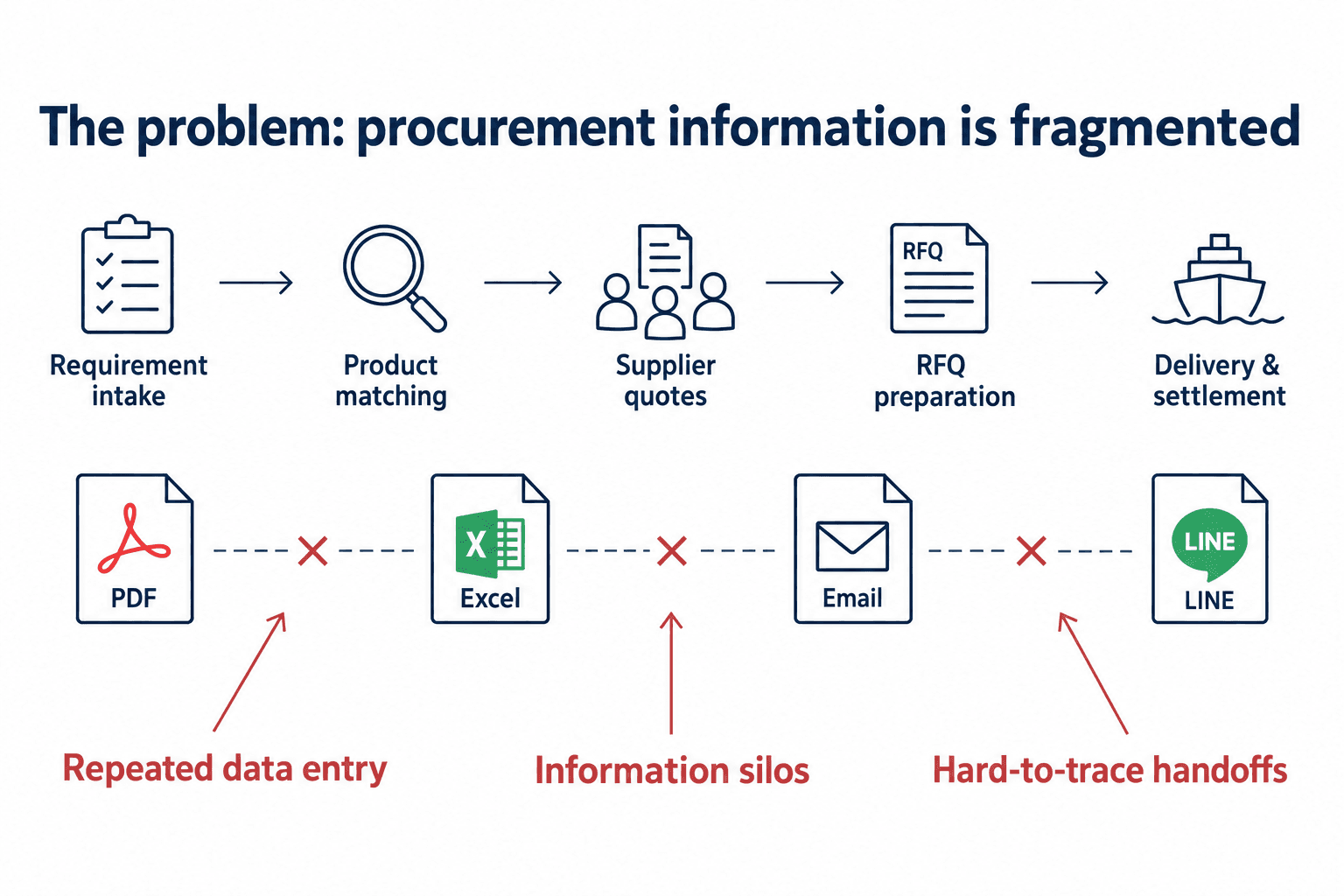
The pain: one procurement journey, disconnected information
The starting point is not simply a difficult PDF. Requirements, product decisions, supplier quotes, logistics and settlement can live across personal experience, Excel, email and LINE. That fragmentation creates repeated entry and information silos, and it prevents the organisation from accumulating reusable operational data. The solution therefore has to evolve the operating model as well as automate document handling.
The coordination problem continues after a request is captured: product matching, supplier quotes, port delivery and reconciliation still need connected records and clear responsibility. Automating one document in isolation would leave the downstream handoffs fragmented.
The solution: shared records, explicit handoffs, controlled automation
To address repeated entry, I connected PDF extraction, classification and order matching to RFQ generation and Excel export. To address information silos, I designed shared records for documents, orders, RFQs and master data rather than separate data flows for each interface. To make handoffs traceable, the operating model names the responsible team, inputs and decisions at each stage.
The LLM agent adds a conversational entry point to these business capabilities; it does not replace the workflow or its controls. Web chat and LINE reuse the same agent, while execution waits for a submitted proposal and user approval. This is the distinction between a standalone chatbot and an agent embedded in a procurement system.
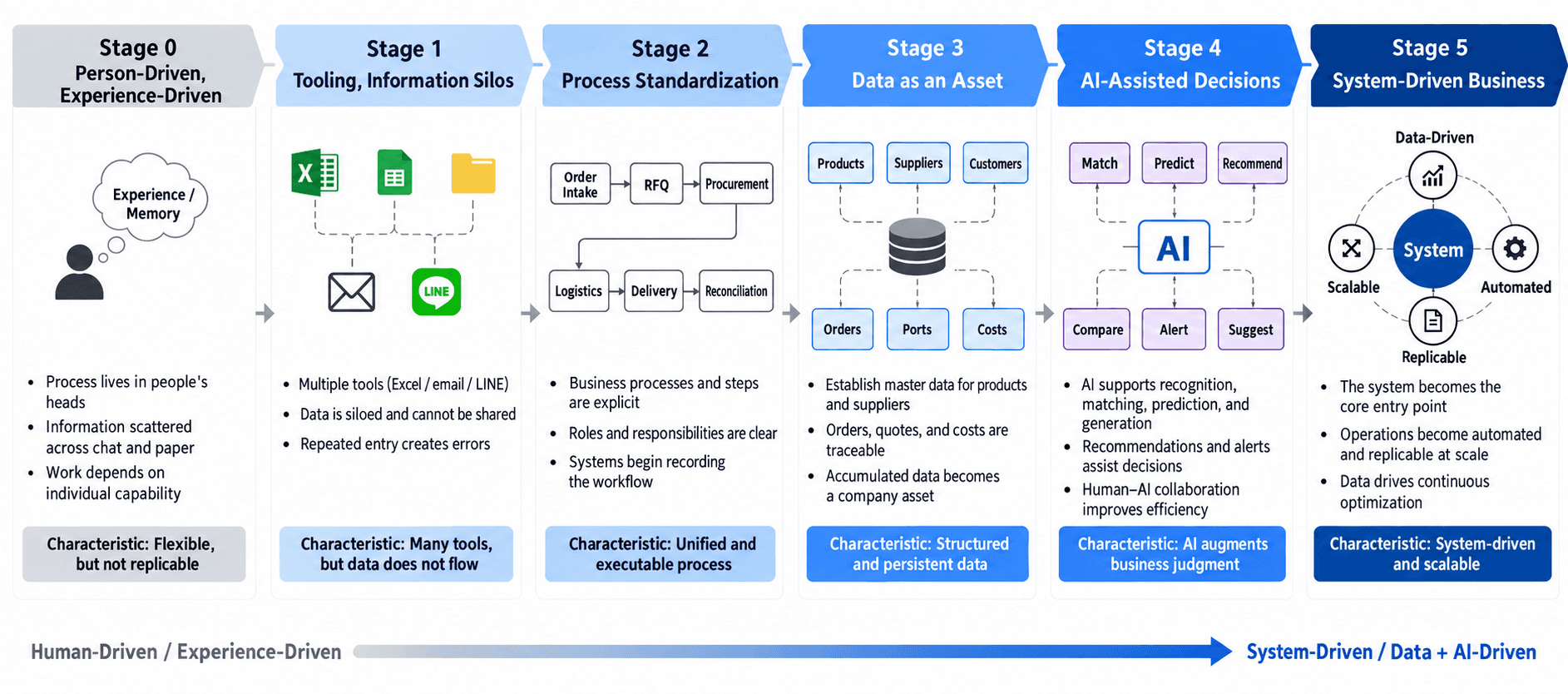
Design the operating model before adding the agent
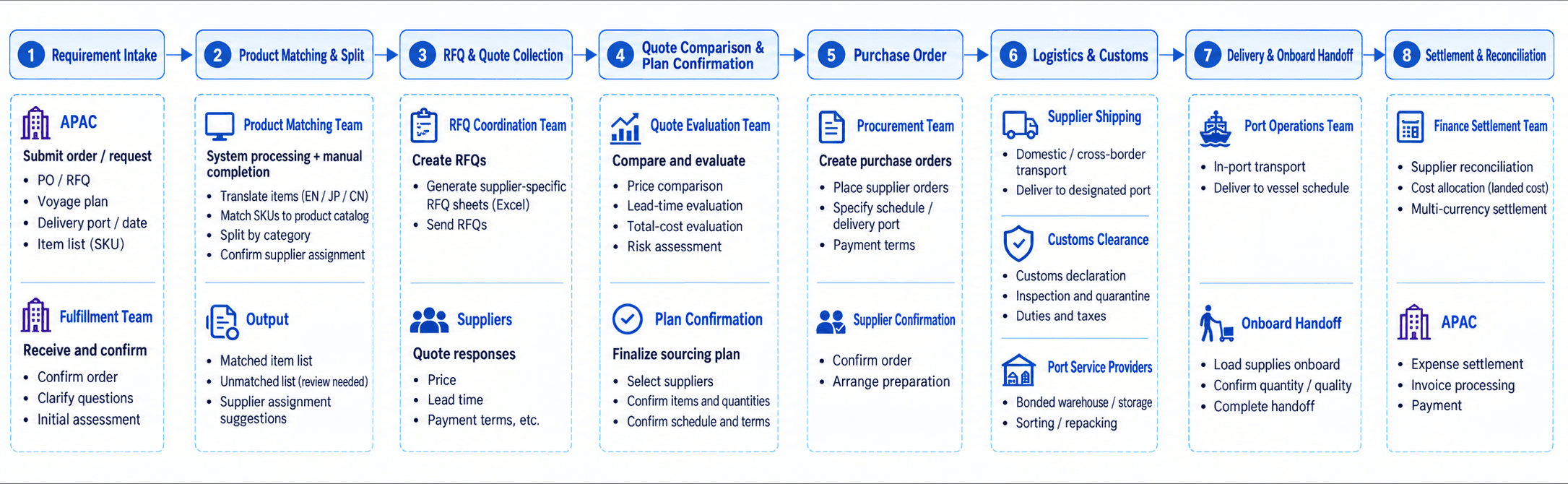
The platform models eight connected stages: requirement intake, product matching, RFQ and quote collection, quote evaluation, purchase ordering, logistics and customs, onboard delivery, and settlement. Each stage names its responsible team, inputs and decisions. This makes the handoffs visible before the software attempts to automate them.
The architecture: one platform, seven bounded business domains
The FastAPI access layer exposes 18 routes above seven business domains: documents, orders, RFQs, master data, settings, identity and LINE. A shared Supabase PostgreSQL model contains 30 entities, while file storage and external services such as Google Document AI remain behind service boundaries. This structure lets web, messaging and background-task entry points reuse the same business capabilities without collapsing them into one monolith.
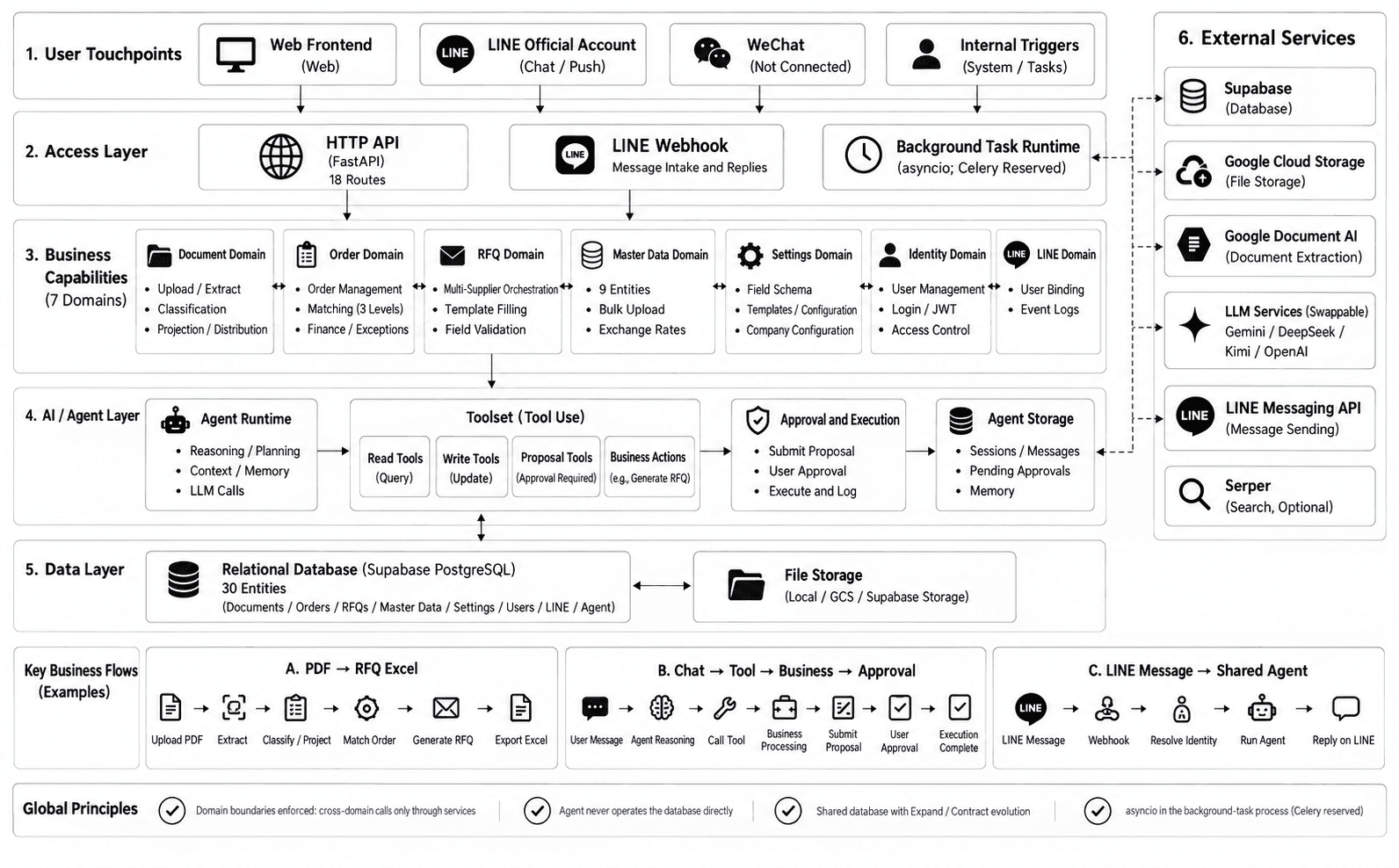
The LLM agent is embedded through tools, not direct database access
The agent runtime handles reasoning, planning, context and memory, then calls a controlled toolset. Read tools query information, write tools update through the service layer, and proposal tools require approval. Business actions such as generating an RFQ enter the same approval-and-execution path. The global rule is explicit: the agent never operates the database directly.
Three concrete paths through the same platform
A PDF can move through extraction, classification, order matching and RFQ generation before export to Excel. A chat request can trigger agent reasoning, a tool call and business processing, but execution waits for a submitted proposal and user approval. A LINE message follows the same shared agent after webhook intake and identity resolution, then returns the response through LINE. Swappable LLM services keep the workflow independent of a single model provider.
What the available evidence establishes
The available materials establish the end-to-end operating model, implemented system topology and approval-gated agent design. They do not establish production adoption, measured accuracy improvement, time savings or return on investment, so this case study does not claim those outcomes.
The finished interface: the actual application, not a mockup
The original application screenshots below show the Japanese-language interface as implemented, not a generated mockup. The order repository brings document upload, order search, status filtering and verified records into one workspace, alongside navigation for products, suppliers and other master data. The login screen provides the entry point to the cruise supply-chain management platform. These screenshots establish the actual interface; they do not demonstrate every agent capability described in the architecture.

